A Peasant Boy’s View of the New World
By Achille Silvestri
My mother, my older brother and I came to America in April of 1939, just six months before Hitler launched his invasion of Poland. We were fortunate that my father, a naturalized citizen, was able to get us out when he did, as the influx of refugees coming from Europe was cut off shortly thereafter. We came from Bugnarra, a rural mountain village in the Abruzzi region of Italy. We settled in this wonderful town of Penns Grove, New Jersey. There were streets, sidewalks, beautiful buildings, cars, everything. We didn’t have anything like that in Bugnarra. Most of the Italian immigrants of that time came from the Abruzzi region. People of Abruzzi are strong, hardworking and incredibly loyal. Companies like DuPont were glad to hire the likes of them and many, like my father, worked for the company their whole lives.
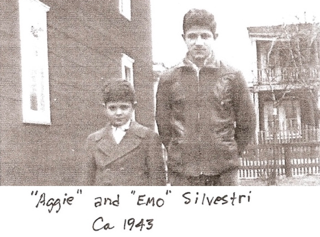
Life in the new world was pleasant from the very beginning... the neighbors were very friendly. But we had to make adjustments to our new surroundings. My name, Achille (which is classical) and my brother’s, Amedeo (which means love of God) were commonplace in the old country. But here in America, they were a little more than the natives could manage. Therefore, I became known as “Aggie” and my brother became “Emo.”
While the integration into our new community progressed relatively well, there was a minor incident to remind us that we were foreigners. Our pride and joy was one of those big old Zenith console radios. One day some men came and took the shortwave receiver out of it. After all, you didn’t know who might try to contact us, there was a war on. In all the confusion following the war we never saw the shortwave again.
We liked school from the very beginning... all the teachers were nice to us. I started in first grade and Emo, who was about five years older, was placed in fourth grade. The first issue was to learn the language. But that turned out to be a minor problem. We just talked to our friends and to the teachers. It worked well even without English as a Second Language (ESL).
My father worked as a laborer for DuPont, and while we were comfortable, there was never an excess of money. Our best value in a house was one that he bought from George Martell, a supervisor at DuPont. It was cheap because it was in the Cabbage Patch, the Negro area of town. I don’t remember that living in the “Patch” was ever a serious issue. Certainly, people didn’t shun us for it. We lived there from the time I started second grade until I got out of high school and we never had a reason to regret it.
Growing up in Penns Grove was fun... I had a great collection of friends. The hardcore of our gang included Jack Finch, Matthew Mitchell, Bob Mattson, Rod Mahaffey, Dick O’Donald, Bill Sorrells and Ken Biddle. There were no girls. Girls were OK, but if you wanted to do some serious playing or imagining you had to have a guy. Besides, girls presented issues that were too complicated for us at that time. We did everything, maybe not all of us did the same thing, but as a group we explored it all. We collected stamps, made pretend money, invented board games, wrote stories and made comics to back them up. We had a board baseball game in which we allocated teams and kept all the numbers and statistics for our teams and players. We built model airplanes, tanks and ships. We played basketball, baseball and football with minimal equipment, just guts and glory and a hardy spirit. And all of that with no electronics, how did we do it! The most sophisticated piece of equipment we had was a mimeograph machine that Jack bought so we could reproduce our pretend money.
This being the WWII period we were very much into warlike toys, soldiers, tanks, planes, etc. I remember in the beginning our soldiers were made of lead. Shortly thereafter, the lead disappeared and we started to make up our models out of cut-out, paper fold-ups. The war had impacted our play so subtly that we were not even aware of it. Near the end of the war we saw something else unusual. They started making all these things out of a material called plastic. It started showing up everywhere, plastic soldiers and models, radios, phones, kitchen accessories... it was all over the place. There wasn’t anything like it.
There was the summer when we held our own Olympics at the riverside park at the end of Main Street. There was a lot of debris from the old barrier wall. We collected some round boulders and flat discs which we used for our strength events, like the shot put and discus throw. And then we would run around The Penn’s Grove National Bank and Trust Company for our sprint competitions. Great fun! Some “winos” or guys down on their luck, hung out at the park. They were mildly amused by us. They, in turn, would entertain us with some outrageous stories of past loves and heroic deeds. It seems strange but these odd lots, us and them, somehow connected with each other. Both had something that the other needed.
Our household started to change when Emo finished eighth grade. At that time earning immediate money seemed more important than an education. So Emo, to help out, quit school and went to work. He was like that, always ready to assume responsibility... like the way he looked after me. No one told him that was his job, he just did it because he thought it was the thing to do. He learned to become a butcher at Banco’s grocery store on Walnut Street. Because of his skills and enthusiasm he was soon earning almost adult wages.
Television came to town about 1947. We saw our first TVs in Chamberlain’s and other department store windows. They would put on a baseball game in the afternoon and we would watch it on those, apparently, huge black and white sets (they were probably 17 inchers). A little crowd would gather around the sidewalk and watch the whole game. One of the gas station owners we knew on South Broad Street kept a TV in his office and he would let us watch with him. I don’t know how many customers he lost because they got frustrated waiting for service. If you were in the know, someone with a TV might invite you to their home for a TV watching party. That was first class. Little were we to realize that we were at the advent of mankind’s largest baby sitter.
A big change in our lives came when we transitioned to Penns Grove Regional High School in 1947. That was the big handsome building on Maple Avenue and Shell Road where Penns Grove and Carney’s Point come together. Because it was a regional high school, we were suddenly thrown in with a lot of people of different backgrounds. Our provincial little community was to be no more. Now we got to know guys and girls from Carney’s Point, Pedricktown, Pennsville, Churchtown, Deepwater, Central Park and all points in between. It brought us a sense of uneasiness. We had everything under control and now we had to validate ourselves all over again. There was new competition in sports and in scholastics. And then there was that thing with the girls. Something happened between the eighth and ninth grades. They looked different and they started to act weird. These were more issues we had to face.
In high school we started to assume other responsibilities. Money became a serious matter, so many of us started to take on part-time work. Dick O’Donald had already worked a number of years at the Factory Outlet Shoe Store. Jack Finch was delivering newspapers and Ken Biddle worked at Farish’s Newsstand. Me, I worked on the farm and did janitorial work in the schools.
Then American Legion Baseball came to town. This was the precursor to what would later become little league baseball and the Babe Ruth League. I’m going to go out on a limb and say I never liked little league baseball. As an adult I coached and my son played little league. But I was never convinced that this was the total success it was purported to be. Before little league came we made up our own teams and challenged other guys we knew that had a team. We would arrange to meet. We would share gloves, sometimes the bat had nails and sometimes the ball was covered with tar tape. We always found a way to play... no grownups required. When the American Legion came they took all that initiative away. They started a league and provided the equipment. Unfortunately, they couldn’t place all the ball players so they took the best. The best usually meant the leaders. They were the ones that would arrange games, account for some sort of practice and anything else it took to put the game in motion. The game fell apart for us secondary players. I didn’t care because we were almost out of high school now. I know there is a net gain in organized little league baseball. But I have to think that something was lost when you took the responsibilities from the hands of those boys and gave it to the adults.
The most dramatic change in our family dynamics came in December 1945. Emo joined the Navy on his eighteenth birthday. It occurred to me that this cushy little life I led was not going to go on forever. I sensed that change was coming and someday everyone would be going his own way. When Emo came home he was different. He wasn’t a boy any more. The Navy took him around the world and showed him things that he could never have imagined in Penns Grove. But he was back and he adjusted. Shortly thereafter, using the skills he learned in the Navy and his experience from his grocery job, he opened up his own butcher shop in a building he shared with Rena’s Bakery.
Growing up in Penns Grove exposed you to a number of interesting elements. Guys always hung out on the corner on Broad and Main Streets. You took it for granted, they were just there. I wondered why would a bunch of grown men spend all day just hanging around the corner? Then I found out. Because that’s where the action was. The bookies held court there. You could place a bet on anything. You could line up a ride to the race track or you could find out where the card game was that night. And Rappa’s Pool Room was just upstairs. If you were feeling lucky you could always find a game of nine-ball, Harrigan, straight pool or odd-ball. And the characters, they were beautiful, Pete the Turk, Ragmop, Lizzie Brown, Pete Reilly, Reds, Shorty, Frank the Tank, Jerry; Damon Runyon would have cried for such characters. And their stories real or imagined still circulate to this day.
My father, Gennaro (he became known as January, the name thing) was not an easy person to know. He mostly confided with adults and my brother because he was older. But there was one way in which I was able to connect with him. He liked to go to South Philly to get some of those good Italian delicacies you couldn’t get, even in Penns Grove. He would take me with him and somehow I always managed to get a toy out of it, not that I was easily bribed. We would ride on the Wilson Line and have a hotdog. It was usually a nice warm Saturday... we would sit by the railing with a light breeze and he would talk to me about baseball. He would tell me about Joe DiMaggio, Phil Rizzuto, Tony Lazzeri and all the other great Italian ball players. And then one day, one of the greatest days of my life, he took me to my first professional ball game. The New York Yankees with Joe D played the Philadelphia Athletics at Shibe Park. I got a souvenir book that had all the teams and diagrams of all the ball parks. There was never anything quite like that.
Neither my dad or my mom, Lucia (she became Lucy, they never got any of the names right) received training or education in English. Still, in their own way, they both acquired a certain rudimentary level of reading skills. Dad did it by bullying his way through the baseball box scores and the attendant stories. Mom, who was the greatest cook I have ever known, gradually learned to read from cooking recipes. And it happened so casually I never knew it was happening. Oh sure, once in a while she would ask what’s this word or what does that mean? But I didn’t really pay much attention. Then one day she showed me a recipe whose content she was challenging and then I realized, “Oh, my god she’s reading!”
In 1950 we started our last year of high school. Jack Finch and some other guys joined the Air Force. Matthew Mitchell had already moved to Florida with his folks. Some of us prepared for college and others trained in business administration. We were well aware that playtime was over... it was time to look forward to new challenges and responsibilities. There was an uneasiness that maybe we would lose track of each other. All in all, however, we have been successful in maintaining many of our contacts. It reflects on the strength of the bonds that are made in those formative years.
Penns Grove left me with many happy memories. It had a great impact in shaping who I would be and what was to follow. I was very fortunate in growing up in a small town where the people knew each other and, in their own way, actually cared. And the best part of it all was something that I could never appreciate until I was older, much older. And that something was this: I was never afraid, I was never hungry, I was never alone and I never wanted for anything. It’s just the way it was in Penns Grove back then...